Korea Compliance Association Charts the Future of Corporate Risk Gover…
페이지 정보
첨부파일
본문
Korea Compliance Association Charts the Future of Corporate Risk Governance at Fourth Annual Conference
-.KCA Brings Together Nation's Top Compliance Minds to Advance a New Standard for Organizational Integrity
-.Public and Private Sectors Align Around Data-Driven, KPI-KRI-KCI Framework in Seoul
SEOUL, March 5, 2026 — The Korea Compliance Association (KCA) marked another milestone in its mission to elevate compliance standards across Korea on Thursday, as it successfully convened the fourth annual Korea Compliance Conference at the Korea Chamber of Commerce and Industry in Seoul. The event, which has grown into one of Korea's most authoritative gatherings in the compliance and governance space, drew senior executives, legal professionals, and risk management practitioners from public institutions and private enterprises alike.
Under the theme "Risk Governance 360: An Omni-Directional Compliance Strategy Anchored in KPI, KRI, and KCI," the conference reaffirmed KCA's role as the country's leading platform for shaping compliance policy, sharing practitioner knowledge, and setting the intellectual agenda for governance reform in Korea.
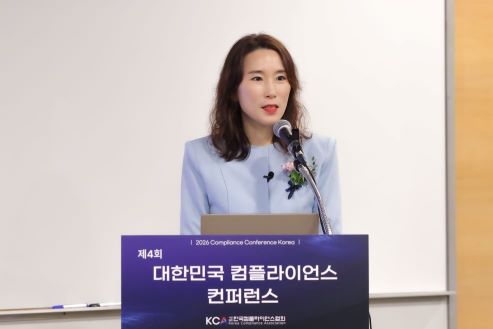
"Compliance has evolved far beyond mere regulatory adherence," said Kim Eun-sung, Chairman of the Korea Compliance Association, opening the day with a keynote address on compliance trends defining 2026. "It is now the foundational management infrastructure upon which organizational trust and long-term sustainability are built." Kim outlined four forces reshaping the compliance landscape: the deepening institutionalization of ESG disclosure requirements, tightening mandatory supply chain due diligence obligations, the rapid expansion of AI and data regulations, and a systemic shift toward effectiveness-centered internal control frameworks. The address set the tone for a conference that sought not merely to describe the changing regulatory environment, but to equip practitioners with the strategic frameworks needed to navigate it.
That ambition was reflected in the caliber and range of speakers KCA assembled for the occasion. Won Gwang-beom, President of Tri-View Risk Management Institute, challenged the audience to rethink how organizations identify risk in the first place, arguing that conventional, single-perspective approaches consistently fail to capture the full landscape of organizational exposure. His call for a three-dimensional analytical framework — integrating internal, external, and environmental factors — provoked lively discussion and drew some of the day's most engaged responses from the floor.
In a session that underscored KCA's commitment to bringing global perspectives to a Korean audience, Noh Ji-hyun, Asia Sales Director of Sayari Labs — a Washington, D.C.-based risk intelligence firm serving U.S. federal agencies and major multinational corporations — presented real-world cases of identifying hidden corporate ownership structures and sanctioned entities within global supply chains. The session illustrated how data-driven compliance tools developed for the world's most demanding regulatory environments are increasingly relevant to Korean organizations operating across borders.
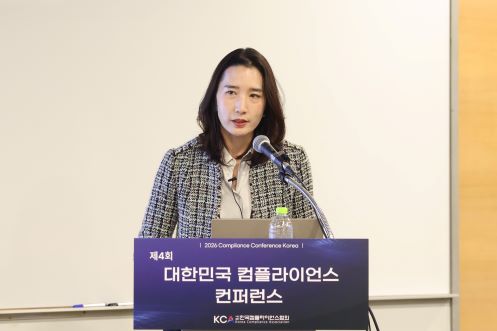
KCA also ensured that the conference addressed what practitioners identified as their most immediate concern: the regulatory implications of artificial intelligence. Kang In-je, a partner at Kim & Chang, Korea's foremost law firm, and Lee Hee-jung, a compliance center director, co-presented a detailed analysis of international AI governance trends and Korea's emerging legislative response. Their session drew a strong reaction from attendees, many of whom are actively designing internal compliance frameworks for organizations in the early stages of generative AI adoption.
The conference's thematic core was delivered by Prof. Park Sung-min of Baehwa Women's University, whose presentation on integrating performance indicators (KPI), risk indicators (KRI), and control indicators (KCI) into a unified governance operating model gave the day's proceedings their intellectual anchor. The framework proposed by Prof. Park — treating the three indicator systems not as parallel instruments but as a structurally interconnected whole — offered attendees a concrete methodology for building governance systems that are both measurable and actionable.
Park Chan-wook, Head of the Compliance Promotion Team at SK Innovation, brought the discussion to ground level with a candid account of how one of Korea's largest energy conglomerates has built and sustained a functioning compliance culture. He detailed the company's three-line-of-defense structure, its systematic identification and management of 377 legal risks across eight domains, and its "Compliance ABC" framework — a culture-building initiative linking Awareness, Behavior, and Culture across the entire organization. He also described SK Innovation's deployment of an AI-powered auditing system designed to shift the company's compliance posture from reactive detection to real-time prevention — a development that generated considerable interest among attendees from organizations at earlier stages of their compliance journey.
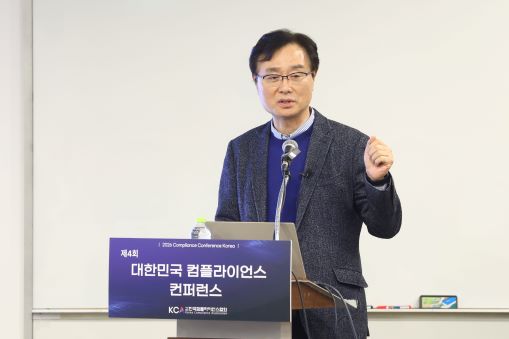
Closing the program, Kim Gwang-gi, CEO of ESG Economy, made the case that governance quality must be treated as a measurable, reportable discipline — not a statement of organizational intent. Drawing on evaluation criteria from the Korea Corporate Governance Service (KCGS), the National Pension Service, and international frameworks including the ISSB and TCFD, Kim argued that board independence, risk management architecture, internal controls, and compliance programs must all be subject to rigorous, quantifiable assessment. "The ability to measure, monitor, and report on governance quality is the defining competitive advantage in the age of mandatory ESG disclosure," he said.
Taken together, Thursday's program reflected the distinctive value KCA has worked to create through its annual conference: a space where the best thinking in Korean compliance — informed by global standards and grounded in domestic practice — can be shared, challenged, and advanced. For an association whose work spans ISO certification consulting, human rights impact assessments, internal control training, and professional certification programs, the conference serves as both a showcase and a statement of purpose.
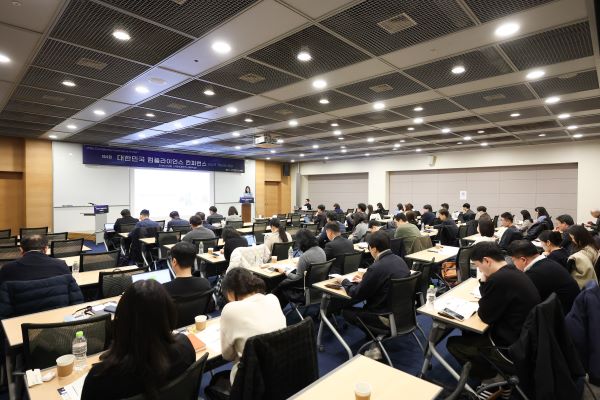
KCA Chairman Kim Eun-sung closed the proceedings with a commitment that the association would continue to expand the policy forums, educational programs, and international partnerships through which it supports the compliance community. "Risk governance must operate within the strategic and operational structure of an organization — not as a declaration, but as a living system," he said. "KCA will continue to build the ecosystem that makes that possible."
The Korea Compliance Association can be reached at admin@kor-comp.org or +82-31-274-1109. Further information is available at www.kor-comp.org
- 이전글제5회 2026 상반기 대한민국 컴플라이언스 어워즈 공모 26.03.12
- 다음글제4회 대한민국 컴플라이언스 컨퍼런스 개최 안내 26.02.04